Hudson Jameson had seen enough.
A member of the sprawling cryptoverse, the 30-year-old had been an early adopter of and believer in digital assets. Jameson first bought Bitcoin in 2011, just two years after its creation. He would go on to make his career in the field, having recently spent five years working at the Ethereum Foundation in various roles. And then, in August, he decided he could no longer subscribe to the cardinal cryptocurrency that is Bitcoin.
Sure, Satoshi Nakamoto’s invention still has the potential to completely upend the global banking system in favor of a decentralized one—but so too do others. The costs of the ravenous levels of energy needed to sustain Bitcoin had become too high, Jameson reasoned. So he cashed out, making him Bitcoin-less for the first time in a decade.
“It’s becoming pretty clear that Bitcoin is either ignoring or making excuses for the environmental issues it’s having,” Jameson, who now heads up operations at Flashbots, told Fortune.
Over the past dozen years, the cryptocurrency community has largely hummed along to the deafening sounds of mining rigs while Bitcoin’s energy usage has ballooned along with its price. The original cryptocurrency now uses about the same amount of electricity in a year as Poland, with a carbon footprint comparable to that of Oman, according to Digiconomist, which tracks Bitcoin’s energy consumption.
At a time when the United Nations’ Intergovernmental Panel on Climate Change is declaring that extreme weather events, food shortages, and animal extinctions will be a part of society’s new reality, concern about the amount of energy required to power Bitcoin has finally reached the national dialogue.
Elon Musk set the stage for renewed scrutiny in May by declaring that Tesla would not accept Bitcoin as payment until it is greener. Sen. Elizabeth Warren of Massachusetts has since called for a crackdown on “environmentally wasteful crypto mining practices.” And Wall Street, where the environmental, social, and governance phenomenon continues to gain steam, seems primed to raise more questions as it dips further into crypto.
“For sustainable and impact investors, it is the tobacco of currencies,” said Erika Karp, chief impact officer at $27 billion family office Pathstone, of crypto in an interview. “That’s kind of a nihilistic view, but that’s the reality.”
The world of digital assets is facing a reckoning over its energy consumption today—possibly opening the door for cryptocurrencies like Cardano, Ethereum 2.0, and Chia that have positioned themselves as more efficient and environmentally friendly alternatives to Bitcoin.
“Crypto is here to stay—this point is no longer up for debate. It is creating real-world benefits for businesses and consumers alike—benefits like faster, more reliable, and cheaper transactions with greater transparency than ever before,” RippleX general manager Monica Long wrote in May. “But as the industry matures, sustainability must be at the center.”
At issue is the proof-of-work structure that the Bitcoin blockchain was built with, which in some ways was the pioneering idea that helped make Nakamoto’s creation unique, secure, and even possible. Proof of work relies on miners racing all day every day to solve mathematical computations that help build the network while keeping it secure, with the winning miners in each of those races earning some Bitcoin in the process. It is a game of scale: The more computing resources a miner puts toward solving those computations, the higher the likelihood they win. And while renewable energy sources are most commonly used to power Bitcoin mining rigs, there are still a good deal of miners relying on coal and natural gas, according to the Cambridge Centre for Alternative Finance.
It’s a necessary cost in the eyes of many Bitcoin fans. Bitcoin is vying to become a type of digital gold, an easily transferable global currency that does not answer to any single governing body. So security is paramount, and proof of work provides just that. “It’s all a matter of tradeoffs,” said Michel Rauchs, digital assets lead at the Cambridge Centre for Alternative Finance. “It’s the very nature of proof of work. It requires a lot of electricity to achieve that level of security.”
Cardano, Polkadot, Solana, and others think there’s a better way forward, though.
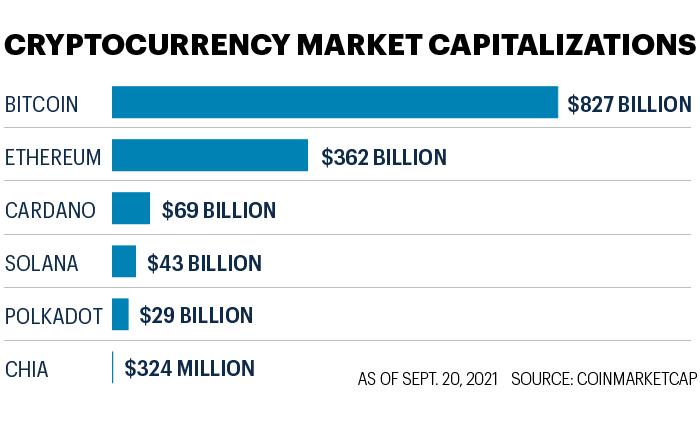
Using a consensus mechanism known as proof of stake, the cryptocurrencies’ blockchains rely on individuals or groups putting up chunks of a platform’s native currency to validate transactions, rather than relying on energy-sucking mining computations (only a fraction of which are successful). Proof-of-stake blockchains can, as a result, run on vastly less sophisticated computer systems, making it easier to scale the volume of transactions without increasing the energy usage, and, therefore, the environmental footprint. Cardano founder Charles Hoskinson says some members of the cryptocurrency’s community have been able to create stake pools on a Raspberry Pi, a single-board computer that fits in your hand and costs $35.
“When we did the Human Genome Project, it cost billions of dollars to sequence the first human genome. Now there’s a company called Nebula, and for $300 they’ll sequence your entire genome,” Hoskinson, an Ethereum cofounder, told Fortune. “Technology allows you to have cost reductions to achieve the same ends that you did before. And it’s the same situation here.”
Launched in 2017, Cardano has been one of the fastest-growing cryptocurrencies this year. Its coin, ADA, has catapulted up the CoinMarketCap rankings in 2021 to become the largest digital asset not named Bitcoin or Ethereum, having risen more than 1,100% since the start of the year, as of Sept. 22.
Cardano bills itself as a third-generation cryptocurrency: one that is decentralized like Bitcoin, has the smart contract capabilities of Ethereum, and, critically, can scale. And while Hoskinson, who started mining Bitcoin from a desktop computer in 2011, may have created Cardano for a much larger purpose than being a green crypto, ecological sustainability was always a part of the calculus, he said.
Solana and Polkadot similarly use proof of stake as their base protocols, though both have added additional systems on top of those. Solana, for example, also uses a proof-of-history protocol that it says helps verify the order and time on its blockchain. Polkadot, meanwhile, uses a variant of the traditional proof-of-stake protocol known as nominated proof of stake.
One of the biggest proponents of proof of stake’s environmental friendliness has been Ethereum inventor Vitalik Buterin. The world’s second-largest cryptocurrency, Ethereum is currently gearing up to switch from a proof-of-work model to proof of stake in early 2022, a move that Buterin has said could cut Ethereum’s energy consumption by more than 99%.
“At this point, in order to be taken seriously as a cryptocurrency or to have a chance of surviving the next 10 years, you need to be able to be flexible and innovative,” Jameson said. “Coins that are doing that are either looking into or actively implementing alternative consensus mechanisms that do not use as much electricity as Bitcoin does.”
Proof of stake is grabbing the attention of sustainability-minded crypto projects, too. BitGreen is looking to possibly create an impact investing market that could connect the “off chain” world of green infrastructure projects with crypto investors. To do that, BitGreen is looking to build on the Polkadot network, its CEO Adam Carver told Fortune.
“We will do for sustainability what Robinhood did for equities in that we will create access for millions of people who want to put their own discretionary investment income into investment opportunities that have a market rate of return and that align with their values,” Carver said.
It is still relatively untested as a consensus mechanism, though. While not new, as its roots trace back to 2012, proof of stake is now the second-largest consensus mechanism. But combined, the cryptocurrencies using it represent only a fraction of Bitcoin’s size. A group of the top 60 proof-of-stake cryptocurrencies held a combined market capitalization of just about $200 billion as of Aug. 24. Bitcoin, by comparison, commands a market cap in excess of $900 billion. The entire crypto market is at around $2 trillion.
And there are questions about proof of stake. In the eyes of Christine Kim, a research analyst at CoinDesk, the environmental benefits of the consensus mechanism are clear. But investors, Kim noted, should be asking as many questions about whether such proof-of-stake cryptocurrencies are doing what they say they will do about their ecological footprint.
“You would never buy a car just because it uses 99% less energy, but the car itself can’t start or make turns,” Kim told Fortune. “The point of building an energy-efficient car is that it’s a great car, but, at the same time, it doesn’t use as much energy.”
Chia founder and CEO Bram Cohen takes issue with the notion that proof of stake is decentralized, as validators could band together and mount an attack to take over a network, even if they risk losing out on the coins they staked to do so.
The BitTorrent founder has instead moved in an entirely new direction with a consensus protocol called proof of space and time. The mechanism still abides by the Nakamoto consensus laid out in the Bitcoin 2009 white paper, but relies on storage space rather than computing power.
Here’s how it works: The so-called farmers on the Chia network allocate unused space on a hard drive for software that puts a mix of cryptographic numbers on the drive in what Chia calls “plots.” Then, when the Chia blockchain indicates a new block is needed, farmers can check if they have a plot closely resembling the challenge. Farmers are rewarded with an XCH token for each verified block they complete by what are known as Timelords, who verify the blocks. So if Bitcoin miners are printing lottery tickets, Cohen explained, Chia’s proof-of-space-and-time model revolves around bingo cards.
“The idea is to get away from the burning of electricity [that’s] doing nothing whatsoever,” Cohen told Fortune. “Now, that’s difficult to do because some resource needs to go into moving the blockchain forward. And such a resource does it exist, it’s called storage space.”
Whether proof of space, time, or some other consensus mechanism beats out proof of work as the cryptocurrency industry’s future is impossible to know today. But investors are already starting to place their bets, even if sustainability is not the driving factor.
For Michael, a Florida-based investor who is active on Reddit, Cardano has been his coin of choice since 2018. Drawn to it by its research-backed structure, Michael, who asked Fortune not to use his last name, has been staking his ADA coins and growing his position that way: “The No. 1 thing that’s going to bring people to crypto is money,” he said. “Everyone wants to make a buck.”
Sustainability was not a factor when Michael first bought in, and he worries that it is going to become “a buzzword” for the cryptocurrency space in the coming years. He realizes, though, that if cryptocurrencies are going to be the money of the future, they likely need to keep the environment in mind: “You can’t run the world’s financial operating system on a token that isn’t sustainable.”
Dive into stories from Fortune’s print edition:
- Crypto traders anonymous: A new addiction takes hold for many as cryptocurrency goes mainstream
- How Toyota kept making cars when the chips were down
- Ethereum risks it all on going green
- NFTy 50: The most influential builders, creatives, and influencers in the NFT world
- The war to charge your electric car is powering up
This story is part of The Path to Zero, a series of special reports on how business can lead the fight against climate change. This quarter’s stories explore new markets emerging in the sustainability space.